
 English
85825

 Introduction to OpenBuild: The grand vision of the Ethereum 2030 roadmap has now been turned into runnable code by AI 4 years ahead of schedule. One person used AI agent programming to integrate the next 8 stages and 65 protocol upgrades into a single client, complete compilation, testing and main network synchronization, allowing future features such as 10,000-level TPS, second-level final confirmation, and 1ETH single-person staking to be fully verified for the first time. This is not only a technical exploration, but also an advance stress test of Ethereum's long-term roadmap: it verifies the feasibility of the architecture, and clearly exposes real challenges such as performance, coupling, and parallel execution, pointing out the direction for Ethereum's next evolution. The following is the original text, compiled and organized by OpenBuild. 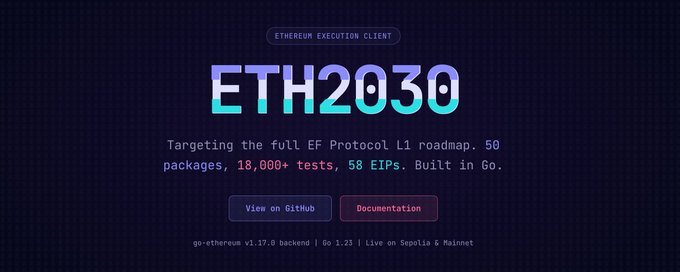 Original title: ETH2030: Agentic Coding ETH Client for 2030+ Roadmap Two weeks ago, I made a bet with Vitalik: One person alone can implement a client for the complete Ethereum 2030+ roadmap with the help of Agentic Coding. Ethereum, which has completed the entire roadmap, will become a truly epoch-making system: the L1 layer throughput exceeds 10,000+ TPS, the final confirmation time is shortened from 15 minutes to seconds, only 1 ETH can be pledged by a single person, a $7 Raspberry Pi can run a stateless node, and the overall L1+L2 throughput exceeds one million TPS. But whether this future can be realized depends on whether the 65 upgrades planned in eight phases are truly compatible and adaptable. These specifications are scattered among dozens of EIPs, most of which are still in the draft stage, and no one has ever tried to consolidate everything into a single code base to verify its composability. So, I did this. ETH2030 (project address: eth2030.com, https://github.com/jiayaoqijia/eth2030) is the result of this attempt - it is an experimental reference implementation for the Ethereum Foundation's L1 protocol draft roadmap. The roadmap was developed by Ethereum core protocol researchers (Ansgar, Barnabé, Francesco, Justin) and covers 8 upgrade stages from the Glamsterdam upgrade in mid-2026 to the Giga-Gas era in 2030+. The entire project was completed based on agent programming: using Claude Code (Opus 4.6), it took about 6 days, the API call cost was US$5,750, and 2.77 billion tokens were processed. It has passed all 36,126 official Ethereum status tests and is embedded with go-ethereum v1.17.0 to achieve mainnet connection. Its functions cover all planned content such as block access lists (Block Access Lists), post-quantum cryptography, and even a complete zero-knowledge proof dedicated RISC-V CPU. Let's get this straight up front: this is not a production-grade client. We are not a client development team either. The current result is just a first draft, 702,000 lines of Go code that compiles, passes tests, and can synchronize with the network. Competitive pressure to verify this roadmap is real: Firedancer has been launched in the production environment on Solana, MegaETH has been released with a target of 100,000 TPS, and Monad's parallel EVM has also been deployed to the mainnet. Ethereum's roadmap is more ambitious than any similar project, but we must not wait until 2030 to find out that components are incompatible. We need senior developers to review the code, point out issues, and help the community figure out what needs to be redesigned before the client team invests in years of production-level engineering development. 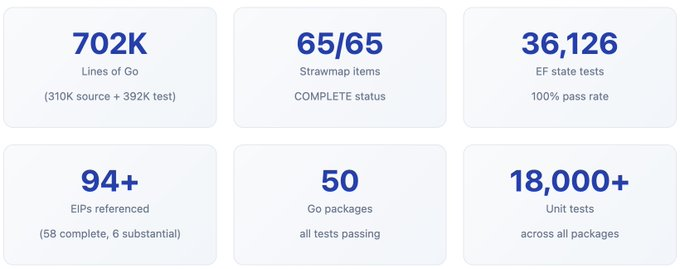 / 01 The core content of the roadmap The Ethereum L1 roadmap divides the overall architecture into three layers - consensus layer, data layer, and execution layer, running through 8 named upgrade stages. Its strategic framework revolves around five pillars:
Each phase introduces functionality at three layers simultaneously, making the roadmap both extremely ambitious and architecturally risky. You cannot launch 3SF alone, you cannot break away from BAL, you cannot break away from Gas repricing, and you cannot break away from Blob scheduling and PeerDAS parameters. They are highly coupled. 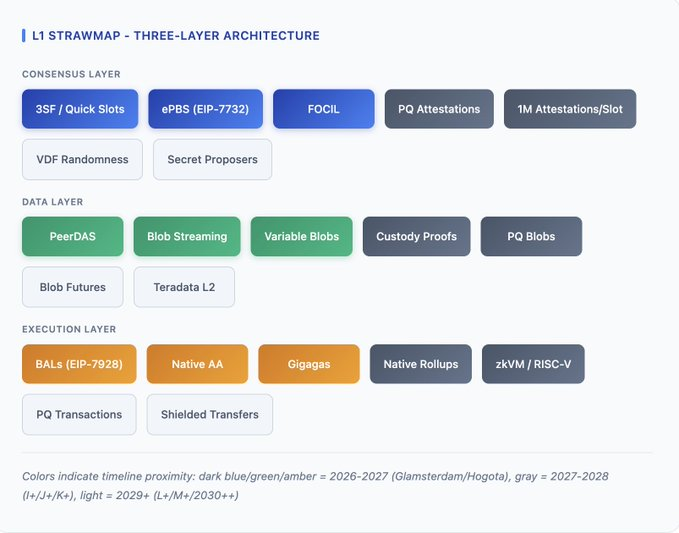 / 02 Solid architectural design The most subtle design decision of ETH2030 is the way it is integrated with go-ethereum (geth). The project did not fork geth, but instead imported go-ethereum v1.17.0 as a Go module and packaged it through a single adapter package pkg/geth/ - this is the only place where geth is introduced in the entire code base of 50 packages. The adapter contains only four files:
Above this layer: consensus, data availability, Rollup, ZK VM, post-quantum cryptography... all are ETH2030 native codes. It is this separation that makes it possible to 100% pass Ethereum state testing. The final binary even embeds the complete geth node: Pebble DB, RLPx P2P, node discovery, snapshot synchronization... and injects 13 precompilers at the specified fork height. It can synchronize the Sepolia test network (about 9000 blocks/second) and can also connect to the main network. 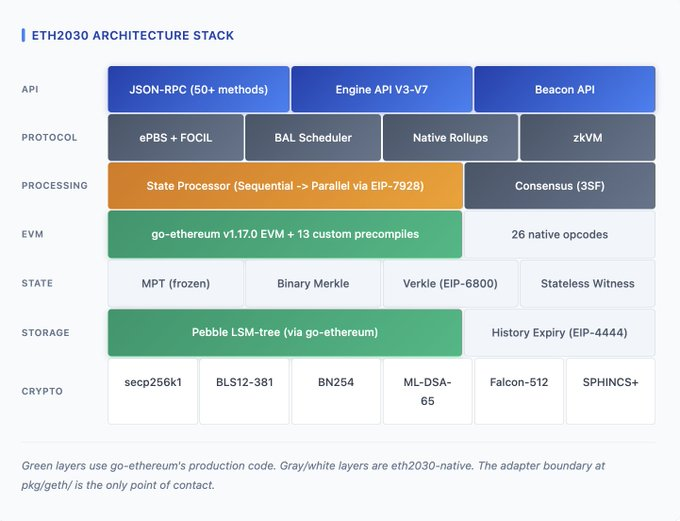 / 03 Implementing all 65 functions, what did I learn? Some things can only be understood after they are truly realized. After writing, compiling, and testing 94+ EIPs in a single code base, I came to 8 key conclusions. 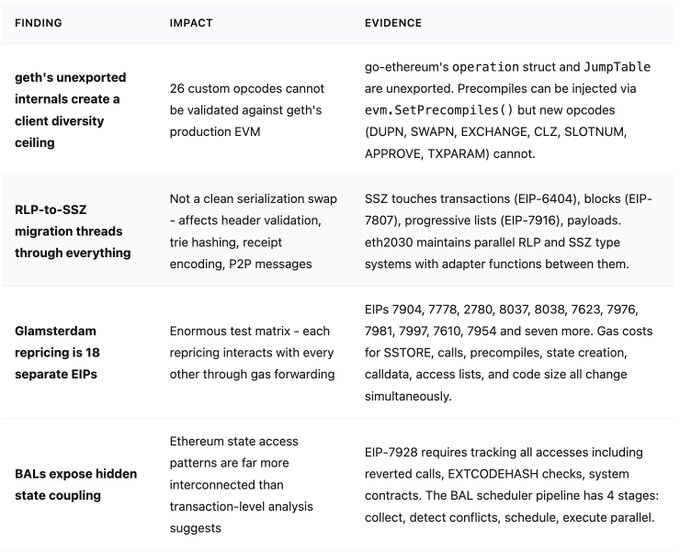 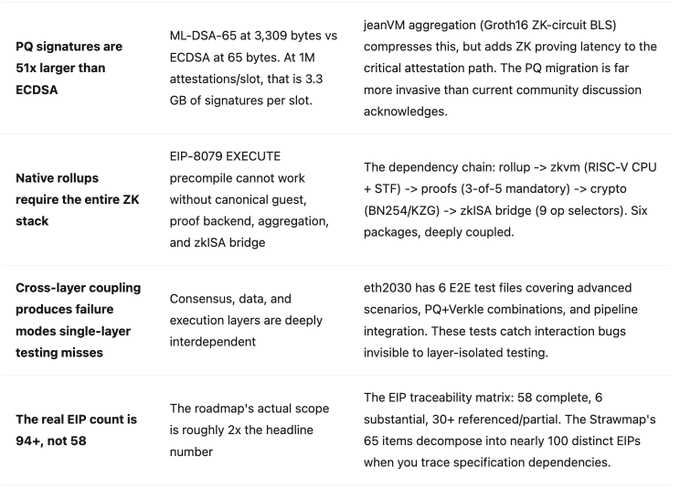 / 04 What are its shortcomings? The most immediate production-grade gap: cryptographic performance. ETH2030 uses pure Go to implement BLS, KZG, ZK proof, Verkle, and post-quantum lattice cryptography. The production client uses a highly optimized C/Rust/hybrid architecture. The performance gap is typically 10–100x. Verifiers running pure Go BLS will miss the signing window by a large margin. The consensus layer architecture is complete but has never been verified in a real network. 3-slot final confirmation, fast slot release, PQ signature, million validator expansion... all functions have Go implementation and verification functions, but none of them handle signatures from the real beacon chain. The Giga‑Gas goals in particular are worth looking at: configured at 1 billion Gas/second, 16 parallel execution slots. Today, the entire Ethereum network only has about 5 million Gas/second. The BAL parallel execution framework has conflict detection, scheduling, dependency graphs, and is theoretically feasible, but real-world conditions—reentrancy, cross-contract callbacks, MEV bundling, ERC20 logic that forces serialization—are far more difficult than synthetic testing. 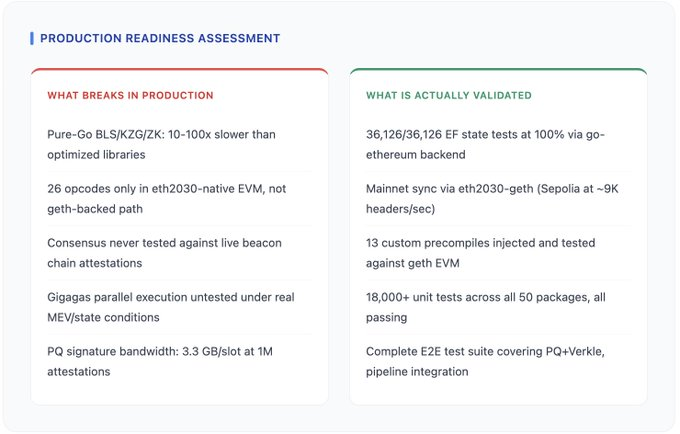 / 05 What the full roadmap will ultimately bring If all 65 items on the roadmap are launched, Ethereum will become a completely different machine from today: almost all core indicators will increase by 1 to 3 orders of magnitude.
This is a very convincing future. 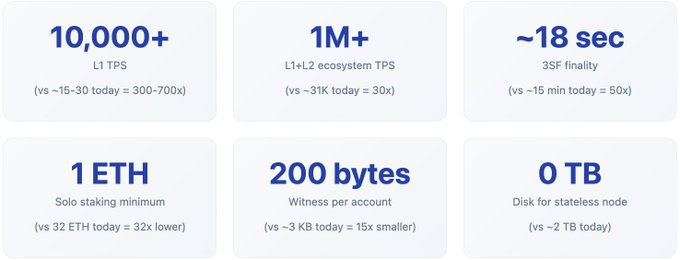 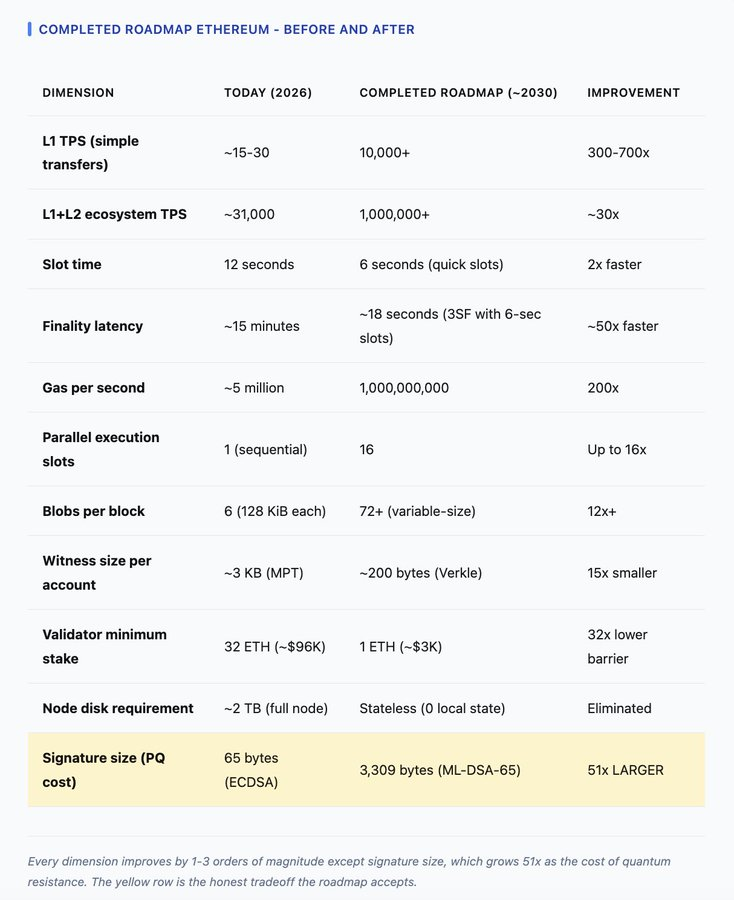 / 06 Horizontal comparison All other projects in this space are just one piece of the puzzle. ETH2030 is the only implementation that covers the entire Ethereum roadmap: 8 stages, 3 layers, 65 features. This breadth is both its unique value and its fundamental limitation. 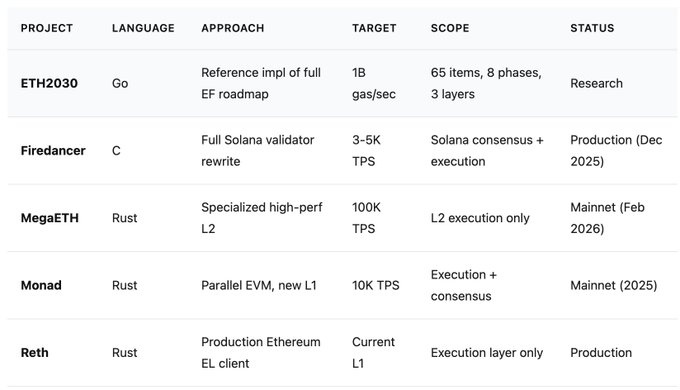 / 07 five years question Some knowledge can only be obtained by "creating" it. By reading EIP‑7928, all you know is that the Block Access List (BAL) is used to track state dependencies for parallel execution. Only after you implement it once will you know: rollback calls, empty account queries, system contract interactions... will all generate state access that needs to be tracked, and the conflict graph is much denser than what you can see from the transaction pool alone. The reference implementation does not produce production-level code, but it does produce production-level problems. From 5 million Gas/second to 1 billion Gas/second, it is not just a quantitative gap, but a gap in Ethereum from the settlement layer to the global execution platform. Whether it can be filled before 2030 depends on four engineering realities:
The components in the roadmap are highly coupled:
Everything came online on time and came together perfectly. But roadmaps rarely come online on time. But even so: all 65 functions are put into one code base, the types are aligned, the interfaces are connected, all 36,000 tests are passed, and the nodes can synchronize with the main network. This is more than most five-year technology plans can do before writing the first line of code. A complete roadmap for Ethereum is a truly aspirational vision. It can be combined. As for whether it can actually go online, that is another question - and this is what the community should discuss now with the code, instead of waiting until 2030, when the cost is irreparable. Original text: https://x.com/yq_acc/status/2026250003577209173 Author: @yq_acc (Translated and edited by OpenBuild, the original text has been deleted) 👇Welcome to join the OpenBuild developer exchange group and get technical information and the latest industry trends as soon as possible!  Add a little assistant or reply to "Community" in the background”   |

|

|

|

|

|