
 English
75731

|
Data can sometimes be deceiving, especially when the base is extremely small. But the trends behind the data never lie. On December 4, within 24 hours after the Ethereum Fusaka upgrade was officially launched, a signal appeared on the chain that was enough to make laymen panic and make experts think deeply: Blob Base Fee soared from the original 1 wei to around 15 million wei, with the peak once approaching 20 million wei. 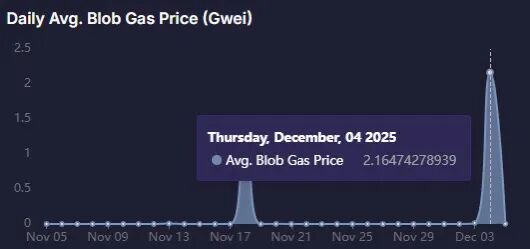 A surge of 15 million times. In traditional financial markets, a cost spike of this magnitude would typically mean hyperinflation or system collapse. But in the encryption world, this is a belated return of value, and it can even be said to be a "righting of chaos." If the previous Dencun upgrade was a "subsidized price reduction" by Ethereum in order to retain L2, then Ethereum after the Fusaka upgrade finally tore off the veil of warmth and began to settle accounts like a mature commercial bank. This is not just an adjustment of technical parameters, but also a carefully planned "two-front battle": on the B side, it ends the free lunch of L2 and starts the cruel survival of the fittest. ; On the C side, it quietly activates hundreds of millions of potential hardware wallets sleeping in your pocket by being compatible with common hardware standards. Ending the Tragedy of the Commons: From “Free Prostitution” to “Payment” Economic AccountingThis time the price jumped 15 million times because the previous price itself was wrong. Before the launch of Fusaka, the Blob market was in an extremely primitive pricing state - lacking a price floor mechanism. As long as the network is not completely congested, the cost of L2 submitting data to the main network is only 1 wei (approximately 0.000000001 Gwei). This absurd pricing leads to a classic "tragedy of the commons": Ethereum's mainnet nodes bear the real physical costs (computing power and electricity) of storage, bandwidth, and KZG proof verification, but receive almost no return. In order to save costs, L2 wants to stuff all the data (including a large amount of junk transactions and brush data) into Blobs. It costs almost no money anyway. L1 essentially subsidizes the wild growth of L2. The core proposal in the Fusaka upgrade, EIP-7918, is essentially an executive order that sets an insurmountable "minimum wage line" for Blob resources. According to the new algorithm rules, the Blob Base Fee is no longer allowed to be as low as dust, but is forced to be anchored to 1/15.258 of the L1 execution layer Base Fee. This is a very smart design: it allows the price of Blob to start to be linked to the real activity (that is, the real value) of the Ethereum main network. This perfectly explains that staggering increase: the previous price was not only cheap, it was unsustainably free. The current price (about 0.01-0.5 Gwei) is still in the low range, but it is enough to cover the physical cost of the node and effectively curb the abuse of junk data. For ETH's economic model, this is the last piece of the puzzle. In the past, investors have criticized L2 for "sucking" Ethereum - taking away transaction volume but contributing very little destruction. With the implementation of EIP-7918, fees return to rationality, and in line with the exponential growth of L2 transaction volume in the future, Blob will transform from a mere expansion tool into a new engine for ETH deflation. According to estimates by Bitwise and other institutions, this mechanism may contribute 30% to 50% of the total ETH destruction in 2026. This is a huge invisible income that is being transferred from the L2 project side's income statement back to the pockets of ETH holders. Farewell to the era of “giant babies”: V God’s ultimatumIn addition to calculating economic accounts, the deeper signal of Fusaka's upgrade lies at the political level: Ethereum is retracting its doting on L2. In the past two years, Ethereum has adopted a "let a hundred flowers bloom" strategy for L2. As long as you call Rollup, I will provide you with extremely cheap block space. This tolerance has led to the collapse of the L2 track - countless project parties rely on fork code and centralized sequencers to issue coins and make money under the banner of "expansion", but in fact they have stayed in the "Stage 0" stage defined by Vitalik for a long time (that is, security completely relies on the project party's multi-signature, rather than code logic, commonly known as "riding with training wheels"). On the eve of Fusaka's upgrade, Vitalik Buterin's tone has undergone a subtle but fatal change. He drew a clear line: If an L2 cannot reach "Stage 1" (i.e., has a valid, permissionless proof of fraud or proof of validity) in the near future, it does not deserve to be called a Rollup. The Blob cost in the Fusaka upgrade has skyrocketed. In fact, L1 is no longer willing to pay for these low-quality L2. This means that 2025 will be the first year of L2’s “Battle Royale”. Those “zombie L2s” that have no real users and no real income and only rely on VC blood transfusions will face a double blow:
The future pattern is very clear: only the head L2 with excellent technology and ecological authenticity can survive, and the rest will be ruthlessly crushed by the wheels of history. Trojan Horse: Activated iPhone and Reduced Hardware WalletIf EIP-7918 is for Ethereum to make more money, then EIP-7951 is for Ethereum to gain more people. For a long time, the mass adoption of Web3 has faced an awkward choice:
Virtually every one of us carries a top-notch hardware wallet in our pocket. Both iPhone's Secure Enclave and Android's TrustZone have built-in military-grade security chips (TEE). The security of these chips is not inferior to that of cold wallets on the market. Awkwardly, these chips use the NIST standard secp256r1 algorithm curve, while Ethereum (inherited from Bitcoin) uses the secp256k1 curve. This tiny difference of one letter constitutes an insurmountable gap in mathematics - when facing Ethereum, mobile phone chips are like foreigners who cannot speak the language and cannot sign directly. The Fusaka upgrade introduces precompiled contracts through EIP-7951, which is equivalent to opening a "green channel" at the bottom of the EVM. Developers now only need to pay a mere 6900 Gas to natively verify the r1 signature of the mobile phone chip. The impact of this change is nuclear bomb-level. It completely reshapes the product logic of the wallet: future users no longer need to know what a private key is, nor do they need to face the psychological pressure of transcribing 12 words. You just need to swipe your face and press your fingerprint like you usually do when buying coffee, and the security chip in your iPhone will directly sign the transaction. This not only has hardware-level physical isolation security (the private key never leaves the chip), but also has a Web2-level silky experience. For Ledgers, this may be a dimensionality reduction blow; But for the Ethereum ecosystem, this is the only way to seamlessly connect 1 billion new users to the chain. The End of Fragmentation and the B2B Finale of the “Ethereum Empire”In addition to the above two points, the Fusaka upgrade also metaphorically confirms the final form of Ethereum: complete B2B. The current Ethereum ecosystem is very much like Europe in the 19th century - hundreds of L2s are like hundreds of small principalities. Although they all respect Ethereum as the royal family, their liquidity is separated from each other, and the user experience is extremely broken. In order to solve this problem, the community is promoting "Based Rollups" (Rollup based on L1 sorting). Unlike the current L2 (which has its own orderer and is an independent kingdom), Based Rollups returns the power of ordering transactions to the validators of Ethereum L1. This is an extremely bold strategy of "cutting down the feudal vassal". It means that L2 will no longer be an independent closed network, but more like a tentacle directly extending from Ethereum L1. Coupled with the cost structure after Fusaka, the future Ethereum L1 will evolve into a pure "global settlement layer". Its direct customers will be left with only two categories:
This is Ethereum’s “coming of age”: it is no longer a geek experiment that sacrifices business logic in pursuit of extreme decentralization, but a digital financial empire with a strict hierarchy, clear division of labor, and strong rent collection. Investor Survival GuideFaced with the drastic changes brought about by Fusaka's upgrade, ordinary investors cannot just watch the excitement. The rules of the market have changed, and your investment strategy must evolve with it. 1. Advice for ETH “death bulls”: deflationary logistic regression, but you need to be wary of the L2 narrative trap
2. Advice to L2 investors: The big purge is coming soon, use this standard to "autopsy"”The L2 tokens in your hand are likely to return to zero. Please review your positions immediately using the following three criteria:
3. Suggestions for interactive parties and wool parties: rising costs, upgraded experience
The Fusaka upgrade is a watershed moment in the crypto world. It tells us: the free lunch is over, technological compatibility has begun, and industry cleansing has arrived. In this revolution, only those who understand the underlying logic can gain a firm foothold in the next wave. About the author: “"Xingyang Talks about the New Narrative of Encryption" is dedicated to the research of new narratives in the encryption industry. The manager has nearly 9 years of industry experience, experienced two bull markets in 2017 and 2021, and gained dozens of times in profits. Since the listing of spot ETFs on January 10, 2024, it has been officially announced that the traditional four-year bull-bear cycle has begun to become blurred, and the indicators of bottom-buying and top-escape that have been tried and tested by retail investors in the past have also become ineffective, making the market difficult to grasp. After years of in-depth research on investment research data in the crypto market, we have explored and summarized a unique set of top and bottom judgment methods, and successfully calculated that BTC and ETH will have three opportunities to escape from the top in 2025. If you have not achieved satisfactory results this year, or even have negative returns, welcome to join our VIP group (V: xingyang2026) to build a robust investment portfolio tailored for you based on your capital volume. Let you seize the opportunities under the new situation in 2025-2026, learn to buy at low prices against the trend, and sell at high prices in time to realize profits.  |

|

|

|

|

|