
 English
66428

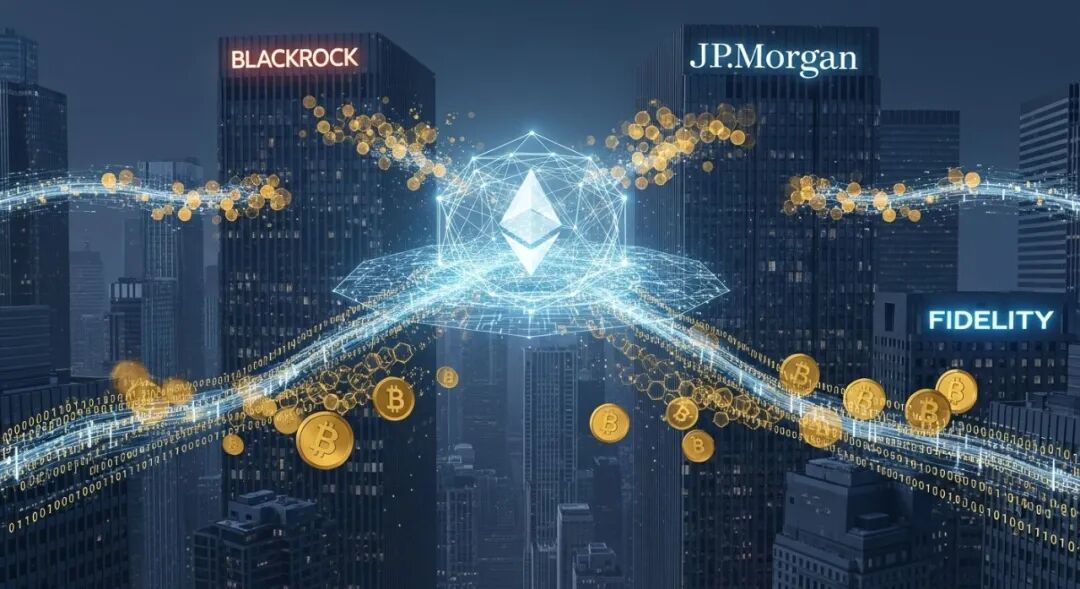 1. Introduction: Paradigm Shift from Experiment to CornerstoneAt the beginning of 2026, the global financial system is experiencing a silent but violent crustal movement. This revolution is no longer about speculative fluctuations in cryptocurrency prices, but about the complete restructuring of the underlying financial “pipelines.” Once viewed as the high-risk, unregulated “Wild West,” Ethereum has now firmly established itself as Wall Street’s settlement layer of choice. According to confirmation from the Ethereum Foundation and multiple market analysts, 35 of the world's top financial institutions, including BlackRock, JPMorgan and Fidelity, have substantially deployed products and services on Ethereum and its Layer 2 network. This shift marks the financial industry’s leap from siled private databases to a unified, programmable public ledger. This "institutionalization" not only verifies the maturity of blockchain technology, but also indicates that capital efficiency, liquidity management and asset ownership structures will undergo fundamental changes in the next decade. 2. Capital territory and performance of market giantsBefore delving into technical and macro analysis, it is necessary to examine the market position of the core listed companies leading this change. The stock price performance of these institutions has shown an increasingly close positive correlation with their strategic layout in the field of digital assets.
3. Strategic turning point: Why is Ethereum the first choice of Wall Street?In the past decade, financial institutions have made a lot of attempts on private chains (such as Hyperledger Fabric, R3 Corda), but ultimately faced the "island effect" of liquidity fragmentation and poor interoperability. The consensus has now been fundamentally reversed: public ledgers provide network effects and deep liquidity that private networks cannot match. The reason why Ethereum wins is mainly due to its positioning as "the world's most secure smart contract platform" and the maturity of its Layer 2 network ecosystem. Layer 2 solutions (such as Coinbase's Base, Arbitrum, Optimism) solve the high handling fees and throughput bottlenecks of the main network, while inheriting the security of the Ethereum main network. For example, JPMorgan Chase moved its JPM Coin deposit token from a private chain to the Base network precisely to take advantage of the public network’s interoperability and round-the-clock settlement capabilities. 4. The on-chain journey of 35 institutions: product and ecological analysisThe layout of these 35 institutions is not superficial, but goes deep into the reconstruction of core business logic. We group these initiatives into three core categories: 4.1 Asset Management and Tokenized Funds (Tokenized Funds)This is currently the most successful institutional application scenario, aiming to migrate trillions of dollars of traditional assets to the chain.
4.2 Bank settlement and deposit tokens (Deposit Tokens)Banks are using blockchain to transform the “pipelines” of the financial system.
4.3 Payment and Stablecoin Infrastructure
5. Technology evolution: building compliant on-chain financeLarge-scale institutional adoption is inseparable from the evolution of underlying technology standards that address compliance, privacy, and scalability challenges. 5.1 ERC-3643: The cornerstone of compliant tokensIn order to meet the strict requirements of KYC (Know Your Customer) and AML (Anti-Money Laundering), the Ethereum community adopted the ERC-3643 standard. Unlike the permissionless ERC-20 standard, ERC-3643 introduces a “permission-based token architecture”:
5.2 Modularization and Layer 2 extensionEthereum’s Dencun upgrade (which introduced the EIP-4844 Blob data structure) and subsequent Pectra upgrade reduced Layer 2 data availability costs by more than 90% and increased throughput to thousands of TPS (transactions per second). This makes high-frequency, low-value institutional trading economically viable, paving the way for mass adoption by the likes of JPMorgan Chase and Visa. 6. Regulatory framework: from hindrance to catalyst2025-2026 is a watershed in global regulatory clarity, with legal certainty removing the last obstacle for institutions to enter the market.
7. Risk assessment and prudential perspectiveAlthough promising, the institutionalization process is not without risks.
8. Endgame Prediction: Global Digital Business Architecture in 2035Looking to the future, Ethereum is evolving from a speculative asset trading platform to the underlying operating system for global digital commerce.
To sum up, the entry of 35 financial giants is not a short-lived experiment, but an irreversible migration in financial history. Ethereum has successfully crossed the gap from "geek toy" to "national financial infrastructure" and is leading the global financial system into a new era of transparency, efficiency and programmability. Disclaimer The information provided in this article is for informational purposes only and does not constitute any investment advice, financial advice, trading advice or other advice of any kind. Companies such as BlackRock, JPMorgan, Fidelity and their related products (such as BUIDL, JPM Coin, BENJI, etc.) mentioned in the article are only used as case studies and do not represent recommendations or endorsements of these assets. The cryptocurrency and digital asset markets are highly volatile and risky, and investors should conduct independent research and consult a professional financial advisor before making any investment decisions. The author and the publishing platform are not responsible for any losses caused by relying on the information in this article. Click to read the original link to search for related articles in previous issues  This article is recommended by "Wall Street Club", please pay attention to the public account: wallstreetclub Statement: This article only represents the author's personal views, does not constitute investment advice, and does not represent the position of this platform. Readers are advised to pay attention to the discussions and opinions in this article. Copyright statement: In addition to publishing original market investment research reports, the "Wall Street Club" is also committed to the exchange and sharing of excellent financial articles. Some articles, pictures and materials are from the Internet, and the copyright belongs to the original ones. The original author could not be contacted in time when pushing. If there are copyright issues involved, please contact the original author by adding WSCHELP WeChat for deletion. Thank you for your permission! about Us The Wall Street Club gathers the high-end resources of Wall Street investment banks to provide a full range of consulting services for Chinese private enterprises to "go global", including listing in the United States, strategic investment, mergers and acquisitions, private equity roadshows and investor relations. Provide practical training from Wall Street investment banking experts in investment concepts and techniques, paving the way for success on Wall Street. Contact us: ecompo@mail.com |

|

|

|

|

|