
 English
77336

 text | Nèi Cān Jun The recent lack of significant price movement in Bitcoin has been putting the patience of crypto traders to the test, as this trendless situation continues. Although there seems to be no sign that this is coming to an end, many crypto observers are wondering when it will all conclude. Should we expect a positive breakthrough, or will it be accompanied by price adjustments? A recent commentary by Tom Lee of Fundstrat, a prominent critic of cryptocurrencies, sheds light on the prospects for this leading digital asset, and suggests that the stock market may play a key role in the next rebound for Bitcoin. After studying the nature of Bitcoin as a safe-haven asset, akin to digital gold, and examining its characteristic risks as well as factors that could influence market sentiment, Tom Lee reached the following conclusions: He believes that when the S&P index reaches record highs, Bitcoin will also rise accordingly. Tom Lee’s research also found that Bitcoin performed best when the annual yield of the S&P 500 index was 15%. Bitcoin has had a lackluster performance Since early July, the price of Bitcoin has been trading within a narrow range, prompting many traders to turn their attention to altcoins. 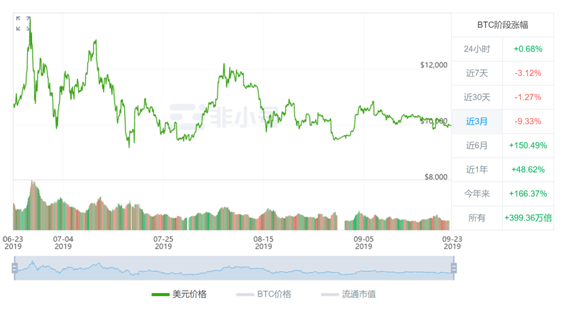 Source: Not the small size As can be seen from the diagram above. In the past three months, the price of Bitcoin has been trading within a range, experiencing a decrease of 9.33%. Especially in the past four weeks, the amplitude of these fluctuations has been gradually decreasing. Although the market generally seems to believe that this lackluster price action is actually building up momentum for a significant upward move in Bitcoin, many traders are still adopting a wait-and-see attitude. The gradual decline in trading volume can be observed in the figure below (Figure 1). Some comments are even more pessimistic, claiming that Bitcoin’s dominance has peaked at 70% and is unlikely to return to the 80% level we saw three years ago. (Figure 2). Figure 1: BTC/USDT daily chart 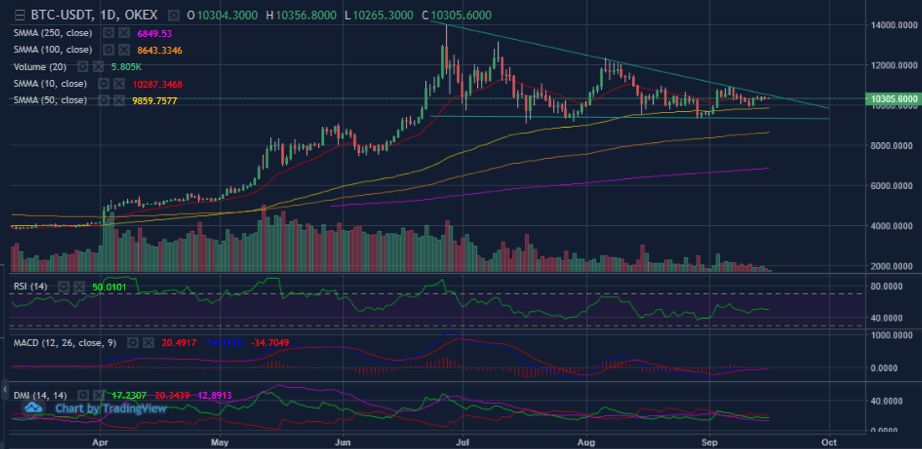 Source: OKEx; Tradingview Figure 2: Total market value of major cryptocurrencies 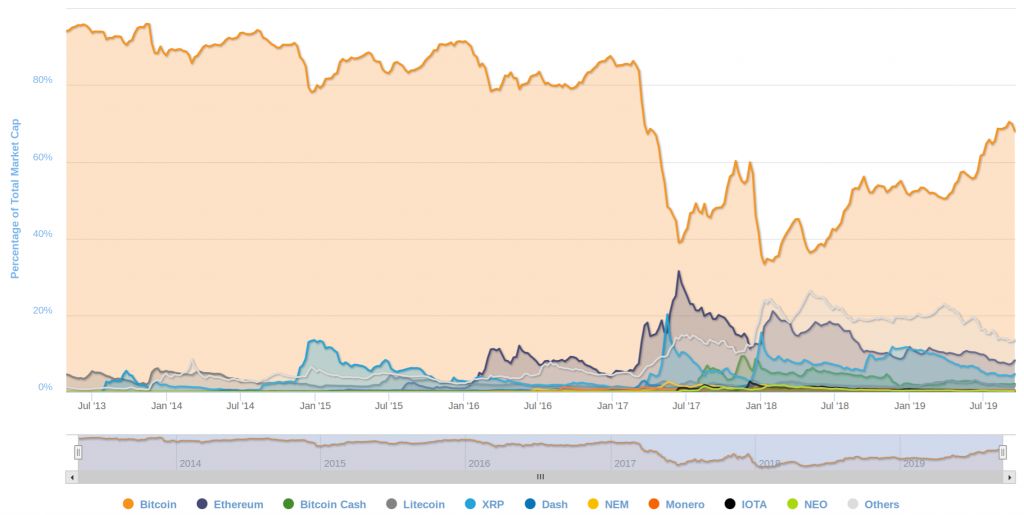 Source: Coinmarketcap Many traders have also begun to focus their attention on other mainstream digital currencies besides Bitcoin. In the recent period, ETH has seen a gain of 10.09%, EOS has increased by 4.98%, and Ripple has risen by 1.84%. Although Bitcoin has remained relatively lukewarm, the multi-factor market index of cryptocurrency broker SFOX predicts a moderately bullish outlook for its future performance. The index was set at neutral on August 5th and was adjusted to a slightly bullish stance on September 9th. 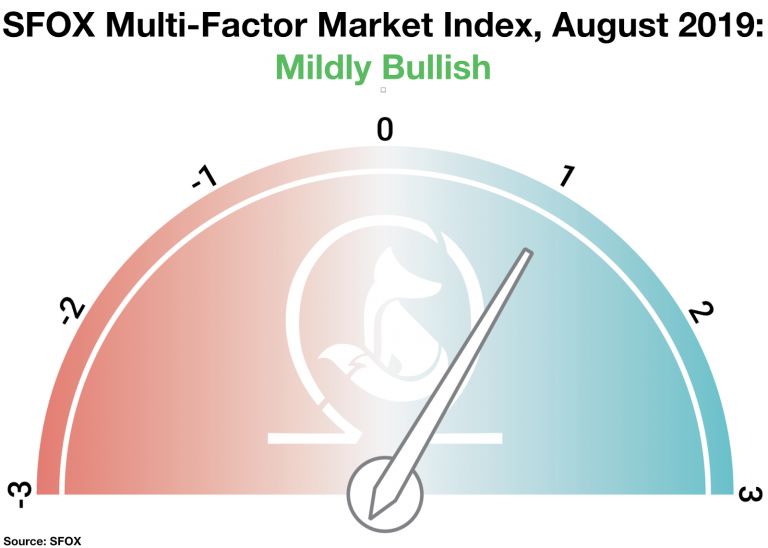 The SFOX Multi-Factor Market Index uses proprietary, quantifiable indicators to analyze three key market factors: price momentum, market sentiment, and the sector’s underlying sustainability, in order to determine the monthly value of the index. It uses a proprietary formula for calculation, which combines quantitative data such as search traffic, blockchain transactions, and moving averages. The index ranges from highly bearish to highly bullish. It is worth emphasizing that this month’s index shows only a slight tendency towards a “moderately bullish” outlook, rather than a “neutral” one. We are witnessing the continued development of BTC and other cryptocurrencies, as well as a significant increase in investor interest. However, there are still uncertainties regarding the future market. The stock market or a rebound in Bitcoin could be the key Not long ago, a prominent cryptography expert revealed the next major development in Bitcoin and the reasons behind it. In an interview with CNBC, Tom Lee, co-founder, managing director, and head of research at Fundstrat Global Advisors, argued that the recent stagnation in Bitcoin’s price trends is influenced by the overall macroeconomic slowdown. Tom Lee added, “In a world without trends, Bitcoin would not rise in value.” ”He stated that Bitcoin would be on the upside when the S&P 500 index reached record levels. Looking back at the past two years, it coincided that Bitcoin also traded within a narrow range when the S&P 500 index was doing the same (Figure 3). It happened twice in 2018, with the most recent occurrence being the latest one. Figure 3: The seesaw pattern in the S&P 500 and BTCUSD 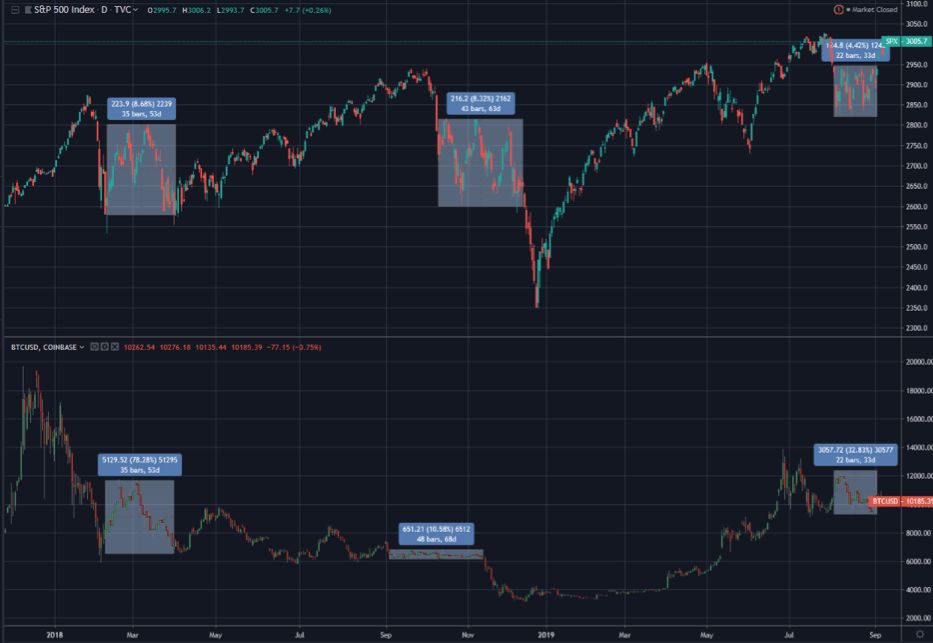 Source of information: Tradingview After a month of consolidation, the S&P 500 index has been gradually approaching its historical high of around 3,027 points (Figure 4). Since early August, the S&P index has been trading within a range, fluctuating between 2,822 and 2,943 points. In early September, the index saw a surge and attempted to regain its July highs, but remained below those historical levels. Figure 4: Annual chart of the S&P 500 since its inception 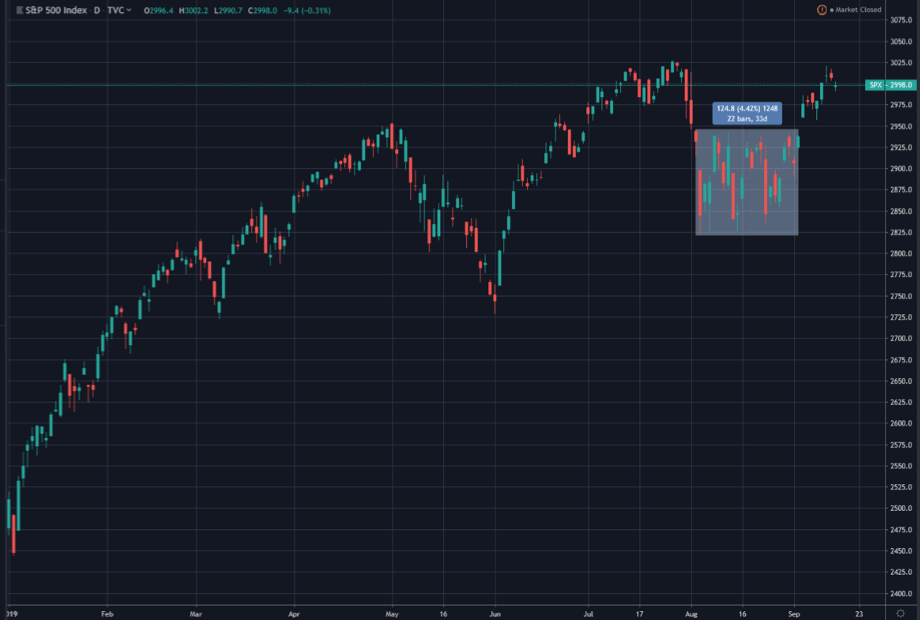 Source: Tradingview Mislav Matejka, Chief Global Equity Strategist at JPMorgan, said in an interview with Marketwatch that he believes the U.S. stock market will rebound before the end of the year. Matyika said, “The key point is that the United States will not experience a recession.” Consumption is strong, interest rates are falling, and there are signs that global economic growth is about to rebound. ” In his research comparing the relative returns of the S&P 500 and Bitcoin, Tom Lee found that Bitcoin performed best when the S&P 500 rose by more than 15% (Figure 5). His findings concluded that Bitcoin is like a coin with two sides. On one hand, when the market is experiencing turmoil, Bitcoin functions much like digital gold; on the other hand, when the market is in a risk-taking mode, Bitcoin can also be considered a risky asset. Figure 5: Relative Performance of Bitcoin vs. the S&P 500 Index Since 2010 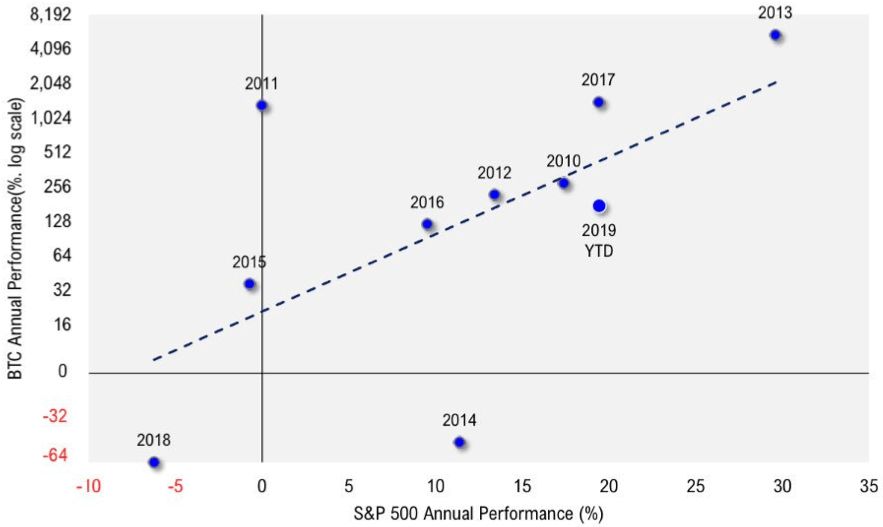 Sources: Fundstrat; Bloomberg; Factset What other factors could influence the trend of Bitcoin? Amid concerns about global trade, negative interest rates, and the potential for an economic recession, debates continue over whether Bitcoin can serve as a hedge against these challenges in the global markets. On August 5th, as the RMB exchange rate against the US dollar fell to its lowest level in 11 years, the price of Bitcoin rose from $10,851.06 to $11,651.75, an increase of over 7%; the price of gold also increased by 1% during the same period. In contrast, on August 15th, when the U.S. Treasury bond market experienced an inverted yield curve, the price of BTC fell by 4%, while the price of gold rose by 0.38%. Such fluctuations may reflect the fact that cryptographic technologies are, to some extent, independent of the volatility of global markets; It may also reflect that investors are simply unsure to what extent BTC constitutes a “safe haven”. As David Martin of Blockforce Capital said, people might currently regard BTC as a speculative investment or a global hedge for investors. The outlook for Bitcoin remains generally optimistic. The institutional platform Bakkt has already begun operations, and it only offers Bitcoin futures products, which is expected to increase demand for Bitcoin. As we enter the final quarter of 2019, there are signs of optimism around the world. Looking ahead, certain macroeconomic events could become catalysts for market developments. Trade optimism: Chinese trade officials will travel to the United States this week in preparation for some high-level trade talks scheduled for later in October. Although many believe that there is still much work to be done before a comprehensive agreement can be reached, the possibility of reaching a temporary and limited trade agreement remains on the table. Meanwhile, Reuters reports that President Trump stated that a trade agreement between China and the United States could be reached before the 2020 elections. More interest rate cuts: The Federal Reserve of the United States once again lowered interest rates by 25 basis points on Wednesday last week. Following the European Central Bank’s reduction of its benchmark interest rate and the resumption of its bond-buying program at the beginning of this month, expectations have grown for further interest rate cuts at the remaining two FOMC meetings this year. Prospects for safe-haven assets: Generally speaking, when market sentiment faces risks, safe-haven assets such as gold and the Japanese yen lose their appeal, and capital flows shift towards higher-risk assets like stocks and high-beta foreign currencies. Let’s take a closer look at the USD/JPY pair, which has been trading above 108 for most of this week. Some analysts believe that the rebound could extend up to 108.85 points. On the other hand, after the attacks on oil facilities in Saudi Arabia, gold prices rose by 1%, but there was still no significant action near the 1500 level. However, the prospects for safe-haven assets still depend to a large extent on how the market interprets the Fed’s forward guidance. Conclusion We have already seen the price of Bitcoin fluctuate within a very narrow range, and traders have now turned their attention to the world of altcoins. However, a well-known cryptography analyst stated that the bullish trend for Bitcoin remains strong, and the rebound in the stock market could trigger a new wave of buying interest in Bitcoin, transforming this leading cryptocurrency from a safe-haven asset into a true hedge investment. However, during a bull market in the stock market, things seem to be somewhat more complicated. text | Nèi Cān Jun Disclaimer: This article should not be used as a basis for investors to make investment decisions, nor should it be interpreted as advice regarding the conduct of investment transactions. Trading digital assets involves significant risks and may result in the loss of your investment capital. Therefore, you should make sure that you fully understand the risks involved and invest carefully. “Chain Inside Reference” is solely intended for sharing information and does not constitute any investment advice. All investment decisions made by users are unrelated to this website.           |

|

|

|

|

|

【Depth】The crossroads of Ethereum (ETH): The 1-hour K-line

Ethereum’s quantum upgrade

ETH seems to be stabilizing, but it is actually a false fire

Solana Foundation Recruitment!

sol market analysis on March 24, 2026

SOL market analysis 3.23

BNB is about to make a comeback!

The most stable method of ETH is exposed tonight!
2026-03-26
2026-03-26
2026-03-26
2026-03-26


 ETH
ETH
